
Watching Monday’s county commission budget meeting was like watching a dysfunctional family battle over money. And, as in many families, things got a little hostile with some commissioners sniping at their fellow commissioners. This behavior left those of us in the audience asking, “Can we not act like adults?”
Monday night’s meeting was the second of two meetings to discuss Mayor Jacobs’ proposed Fiscal Year (FY) 2026-2027 budget. While the property tax rate remains constant at $1.5540, the overall budget (including schools) increases 2.7% from the previous year. The General Fund Budget increases 4.3%.
According to the budget (which you can find here), “sales tax growth is budgeted to increase by $13.7 million over the FY 2025-2026. This increase is mainly due to revenues exceeding the budget in the current fiscal year. Current property tax revenue is expected to increase by $7.7 million.”
A Closer Look at the FY 2026-2027 Budget
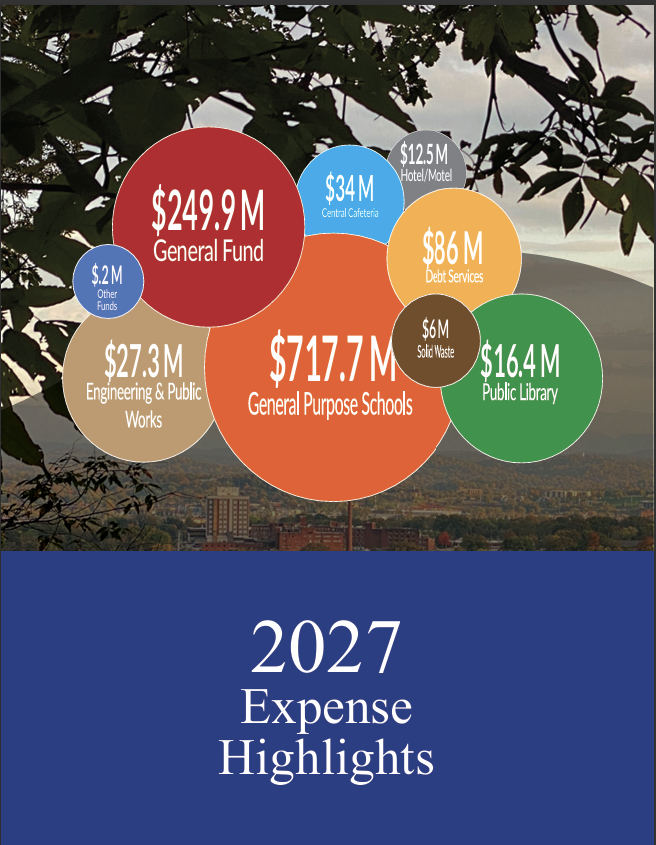
To make it easier to visualize the budget, I’ve included Mayor Jacobs’ chart found in his budget proposal. The size of the circle seems to be in proportion to the amount budgeted. You can find the more than 50-page missive by clicking here. To get a true feel for the budget, I would suggest printing it. Having a paper copy proved to be very helpful in accessing the pages that commissioners were referring to.
As you can see, the “General Purpose School” portion of the budget is a whopping $717.7 million, which is an increase of $17.2 million from last year’s budget. Not included in the “General Purpose” portion is the $34 million “Central Cafeteria” portion that is funded through “federal and state revenues for the school lunch program and sales to students and adults.”
According to Mayor Jacobs, 69% of the overall budget is school-related expenditures. Let that sink in…69% of the overall budget that he is proposing for Knox County for FY 2026-27 is school-related expenditures.
The Voters Spoke, and Commissioner Russell Listened
Is it any wonder that the biggest disagreement at Monday’s meeting involved funding for Knox County Schools? In an attempt at fiscal responsibility, Commissioner Angela Russell proposed decreasing the funding of schools by $13 million, which would still leave an over $4 million increase over last year’s budget. She proposed the remaining $13 million be allocated for road paving, a top priority of constituents across the county. When questioned by Commissioner Lee, county employees said this $13 million could pave 75 miles of road in addition to the 40-45 miles that are currently funded.
Why Is the School Budget Growing so Much Faster Than Other Departments?
In defending her proposal, Russell contrasted the growth of the sheriff’s department budget to the growth of Knox County School budget. The net increase of the sheriff’s department budget from 2020-2026 was 24%; the net increase of the school budget was 44% (see page 25 of the budget).
While some commissioners debated that the increase didn’t count because some of the increase in funding came from the state, the fact remains that the Knox County School Budget increased at almost twice the rate of the sheriff’s office regardless of where the money comes from.
As support for her proposal to change the budget, Commissioner Russell reminded commissioners that during the same time the funding had gone up for schools, the population they serviced had gone down 3%.
Several commissioners brought up that the increase in funding is supposed to help fund the teacher pay raise the State of Tennessee is mandating. Commissioner Russell at no time suggested that the teachers did not deserve a pay raise. But the question has to be raised: Is giving Knox County Schools an additional $13 million a fiscally responsible decision?
As a taxpayer, I would like to know where all this money is going. In fact, during this meeting, Knox County School personnel informed the county commission that they had eliminated 130 positions over the past two years. Where did that money go?
Let’s Just Add on Another $62.8 Million in Debt
In addition, Commissioner Russell reminded commissioners that with this new budget, commission would be voting to increase the debt by 62.8 million (see page 42 of budget) for a new school. She suggested that this capital expenditure item be delayed until more research could be done. Unfortunately, Commissioner Russell’s fiscally responsible suggestions were only accepted by Commissioners Lee and Fox.
How Does This Work?
In an unexpected twist, Commissioner Gina Oster dropped a bombshell near the end of the meeting by proposing that county commission give Knox County employees an additional 3% raise for a total of a 6% pay increase this year. The raise is not the problem; it’s where she got the money.
She emphasized this wouldn’t increase the budget; they would simply move money from the Knox County School reserves. Apparently, this is acceptable because the Knox County School Reserves currently has $71 million in it, and state law only requires 3%, or $21 million.
While everyone knows that our county employees deserve this additional raise, this bombshell dropped on the conservative members of the commission allowed no time to determine the future repercussions of such an action.
Public Involvement is Vital
In my opinion, this left the conservative commissioners with little choice but to abstain or pass, given that the employee raise amendment was fiscally irresponsible and provided insufficient time to assess the consequences of shifting funds.
This entire episode left a bad taste in my mouth, particularly Chair Oster’s remark implying that abstaining/passing equated to opposing a raise for county employees. In my view, such a comment was inappropriate. Attempting to publicly shame fellow commissioners for exercising fiscal responsibility is reprehensible.
Watching this “dysfunctional family” meeting has only served to highlight the importance of public involvement in county commission. Because of the time of the meeting, most people were unable to attend. Perhaps if county commissioners knew they were going to be closely monitored by their conservative constituents, this type of dysfunctional behavior would not be tolerated. Regardless, there is an election coming up, and we have the opportunity to change the composition of the commission. Let’s make sure we do.
If you would like to view the meeting and judge for yourself, you can access that meeting by clicking here.